Top Global Fraud Index Reports to Watch in 2026
The global digital economy in 2026 is characterized by a definitive shift from high-volume, opportunistic cybercrime toward high-precision, AI-orchestrated deceptions that challenge the foundational principles of institutional trust. As organizations transition from experimental artificial intelligence toward what is now termed “accountable intelligence,” the landscape of fraud has evolved into a professionalized ecosystem where adversaries utilize autonomous agents and sophisticated deepfake technologies to bypass traditional defenses.
These reports represent the essential intelligence required for risk officers and compliance leaders to navigate an era where the boundaries between human and machine-initiated fraud have become increasingly opaque.
Civoryx Scam Trend Score
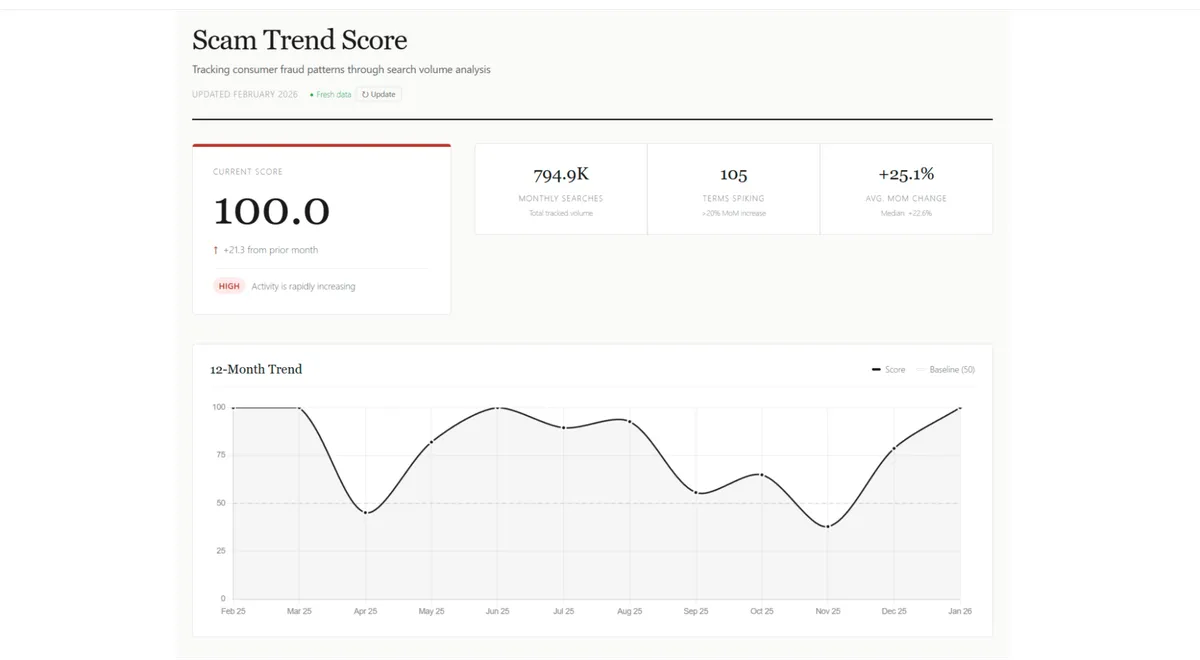
The Civoryx Scam Trend Score serves as the primary heartbeat of the Global Fraud Index. It is a data-driven, transparent metric designed to track how fraud attention shifts across the internet in real-time, removing speculation and opinion from the conversation about global security.
What is the Scam Trend Score?
The Scam Trend Score is a composite metric that aggregates month-over-month search volume changes across a curated index of fraud-related keywords. Because fraud often evolves faster than traditional news cycles, this score surfaces shifts early—giving researchers and the public a “lead time” on emerging threats before they peak in the headlines.
The 2022 Keyword Expansion
A pivotal moment in the index’s precision occurred in 2022, when Civoryx significantly expanded its tracking capabilities. To provide a more comprehensive view of the landscape, the keyword index grew from 80 to over 150 fraud-related terms. This expansion allowed for deeper coverage of diversifying scam types, including:
- Phishing and Identity Theft
- Crypto-specific Scams
- Romance Fraud
- Niche and emerging fraud tactics
How the Score is Calculated
The score is built on a three-layer methodology to ensure that high-impact trends are prioritized over statistical noise.
| Phase | Action | Description |
| 1. Monitor | Keyword Tracking | Continuous tracking of 150+ terms across various fraud categories. |
| 2. Measure | Weighted Velocity | Calculates month-over-month change. Keywords with higher absolute search volumes are weighted more heavily to ensure a clearer signal. |
| 3. Score | Aggregation | Weighted changes are merged into one composite score. A rising score indicates accelerating global fraud interest; a falling score indicates it is cooling. |
Accessibility and Mission
Civoryx is built on the principle that fraud transparency should not have a price tag. The data is treated as a public utility for compliance teams, cybersecurity professionals, journalists, and everyday consumers.
- Cost: $0 (Permanently free)
- Access: Public index, no account or registration required.
- Updates: The score is updated regularly to reflect the most current search data.
The data is open because the problem is universal — Civoryx Core Philosophy
Sumsub Identity Fraud Report

The Sumsub Identity Fraud Report 2025–2026 shifts the analytical focus toward the technological evolution of identity-based attacks, highlighting a 180% surge in “sophisticated fraud” attempts globally. This metric is particularly significant as it indicates that while the overall fraud rate decreased slightly—from 2.6% to 2.2%—the attacks that do occur are far more complex, often involving multi-step schemes that combine several advanced techniques within a single verification attempt.
Deepfake technology has reached a point of maturity where it now represents a primary threat to visual and auditory trust. The report notes that deepfake incidents nearly doubled in European markets such as the UK and France in 2025, with the Maldives experiencing a staggering 2100% year-on-year increase in deepfake attacks. This surge is powered by the “industrialisation” of AI-assisted forgery; tools such as ChatGPT, Grok, and Gemini are now used to create 2% of all falsified documents processed globally, a figure expected to reach double digits by late 2026.
Top First-Party and Third-Party Fraud Schemes
The following data clusters represent the primary methods employed by fraud actors in 2025 and 2026, as categorized by Sumsub.
| Fraud Type | Primary Method | Global Share (%) | Key Characteristics |
| First-Party | Synthetic Identity | 21% | Use of fabricated data by the actual user. |
| Chargeback Abuse | 16% | False claims of unauthorized transactions. | |
| Application Fraud | 14% | Identity misrepresentation during onboarding. | |
| Deepfakes / Money Mules | 11% (each) | AI-generated personas or moving stolen funds. | |
| Third-Party | Identity Theft | 28% | Exploitation of stolen credentials. |
| Account Takeover | 19% | Unauthorized access to legitimate accounts. | |
| Card Testing | 17% | Validating stolen card data via small charges. | |
| Social Engineering | 16% | Manipulating victims into providing access. |
Source: Sumsub Identity Fraud Report 2025-2026
A defining trend for 2026 is the shift from “content to context.” Fraudsters are increasingly targeting the telemetry layer of verification, including SDKs, APIs, and device signals, to mask the origins of an attack. This technique involves bypassing the visual verification entirely by injecting fraudulent media directly into the data stream, a method known as an injection attack. The report posits that the next frontier of defense will involve the verification of “AI agents” themselves—confirming not just the identity of the user, but the legitimacy of the digital entity acting on their behalf.
Geographically, Sumsub’s data shows a notable downward trend in Western countries—with a 14.6% decrease in North America and a 5.5% decrease in Europe—contrasted by sharp increases in Africa (+9.3%), APAC (+16.4%), and the Middle East (+19.8%). Specifically, countries like Zambia and Cambodia have emerged as hotspots for fraud networks, while Malaysia saw a 197% year-on-year growth in identity fraud. This regional volatility suggests that as Western institutions harden their defenses, global criminal syndicates are pivoting toward emerging markets where digital onboarding is expanding faster than regulatory oversight.
Veriff Identity Fraud Report
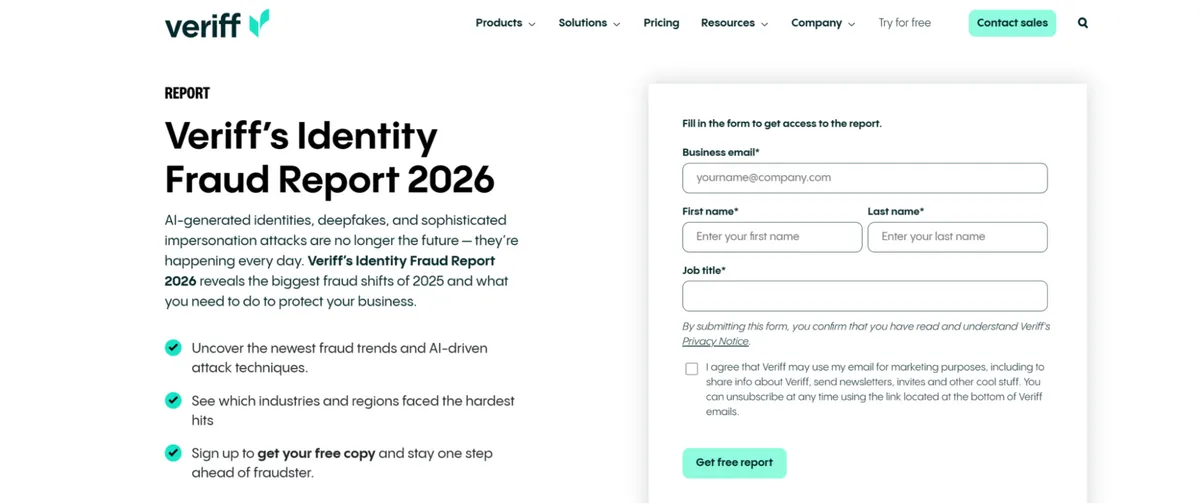
Veriff’s Identity Fraud Report 2026 provides a detailed examination of the “E-commerce Marketplace Crisis” and the continued dominance of impersonation fraud. The report finds that approximately one in every 25 online identity verification attempts involves someone posing as another person, with impersonation fraud accounting for more than 85% of all fraud attacks in 2025. The most alarming statistic from Veriff’s research is the net fraud rate for e-commerce sites, which reached 19.2%—nearly five times the global average.
The decline of traditional document fraud, which dropped by 13% year-over-year, indicates a strategic shift among fraudsters who have recognized the difficulty of defeating modern liveness and biometric checks with physically altered IDs. Instead, they are turning toward “Emulator Attacks” and “Injection Attacks.” Emulator attacks involve software that mimics a legitimate mobile device to bypass device-based detection, particularly in financial services where fraud rates were 30% higher than the global average.
Industry and Regional Fraud Vulnerabilities
The table below summarizes the net fraud rates across different industries and the dramatic regional shifts observed by Veriff’s fraud platform.
| Industry / Region | Net Fraud Rate / Metric | Key Insight |
| E-commerce / Marketplaces | 19.2% | Sophisticated networks targeting high-volume sellers. |
| Financial Services | 5.5%+ | 38% YoY increase in lending and crypto platforms. |
| EU and UK Region | 2.3x Increase | Surge driven by newly measured activity and anti-fraud adoption. |
| Latin America Region | +32% | Highest regional increase in total fraud attempts. |
| Video Gaming / Social Media | 2x Global Avg. | Used as early digital touchpoints for building rapport. |
Source: Veriff Identity Fraud Report 2026
One of the most distinctive trends identified by Veriff for 2026 is “Polygamous Working” fraud. This phenomenon involves individuals working multiple full-time remote contracts simultaneously—sometimes as many as 14 at once—by using fraudulent reference houses and AI-generated identities. A high-profile case cited in the report involved an individual holding four separate jobs across UK government agencies, highlighting a critical vulnerability in the remote hiring process. This suggests that “Right to Work” and employment screening are no longer just administrative tasks but have become front-line fraud prevention concerns.
Veriff also notes that digitally presented media was 300% more likely to be AI-generated or altered in 2025 than in the previous year. The report stresses that while AI fraud still represents a small fraction of total attempts, its growth rate is exponential. The cross-border nature of these threats is evidenced by the rising importance of “cross-border fraud” strategies, as global scammers exploit jurisdictional gaps and the speed of real-time payment systems to move illicit funds before they can be flagged.
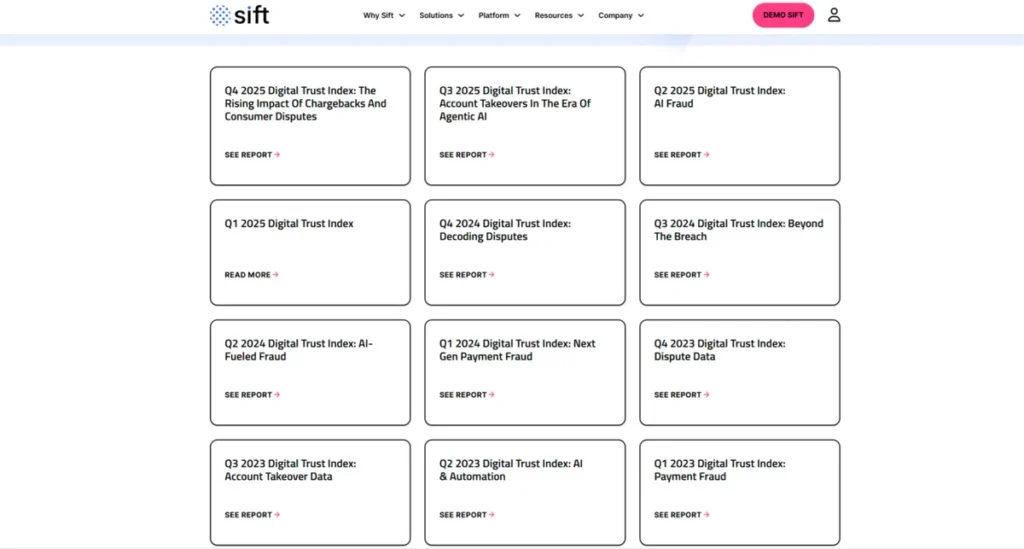
Sift Digital Trust Index
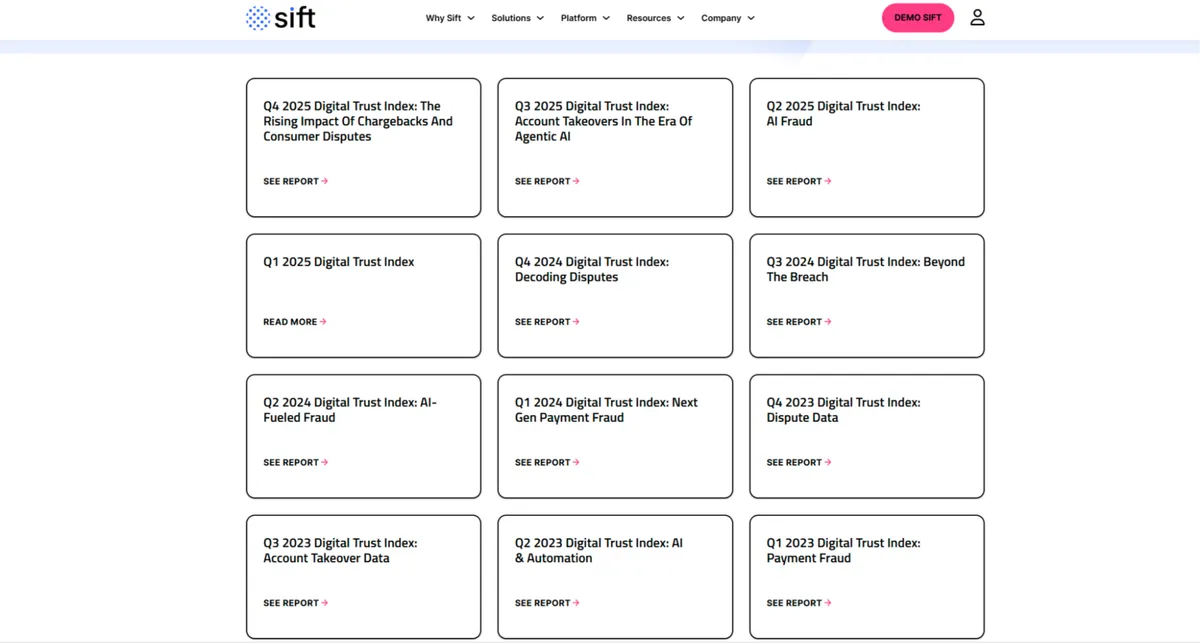
The Sift Digital Trust Index focuses on the “Fraud Economy” and its intersection with consumer psychology, specifically tracking the explosion of the “Refund Hack” economy. Sift projects that global chargeback losses will climb from $33.79 billion in 2025 to $41.69 billion in 2028. The index uncovers a troubling trend: 22% of consumers have encountered “refund tutorials” on platforms like TikTok and Facebook, and 10% admit to having tried these tactics themselves. This democratization of criminal techniques has made first-party fraud the world’s most prevalent fraud type, representing 36% of all reported fraud in 2024—a 140% increase in share from the previous year.
The report identifies a “One-and-Done” effect on consumer loyalty, where 62% of shoppers say they would stop using a brand entirely after experiencing fraud or a poorly managed dispute. This puts immense pressure on merchants to balance security with a frictionless experience. Furthermore, the index suggests that economic pressure is eroding ethical boundaries; 20% of consumers state they would be more likely to engage in “friendly fraud” during periods of financial hardship.
Chargeback Value and Frequency Trends
The following table details the industries seeing the most significant jumps in chargeback rates and values, indicating where the fraud economy is most active.
| Industry | Rate Change (YoY) | Value Change (YoY) | Key Driver |
| Retail E-commerce | +233% | +48% | Big-ticket holiday buying and targeted attacks. |
| Transportation / Travel | +226% | +17% | Fluctuating plans and service dissatisfaction. |
| B2B Software / Services | Normal Rate | +50% | High-value contracts magnifying each loss. |
| Online Travel Agencies | +51% | Normal Value | Rising sensitivity around refund flexibility. |
| Commerce Marketplaces | +45% | Normal Value | Complex third-party seller ecosystems. |
Source: Sift Q4 2025 Digital Trust Index
A critical regulatory catalyst for 2026 noted in the Sift report is the shift in Visa’s Acquirer Monitoring Program (VAMP). On January 1, 2026, the threshold for “excessive” chargebacks will drop from 1.5% to 0.9%, and merchants exceeding this limit will face a $10 fee per disputed transaction. This shift will likely force a massive re-evaluation of pre-transaction fraud prevention strategies, as the cost of “doing nothing” becomes prohibitively expensive.
The Sift index also explores the trust gap emerging from “Agentic AI.” As AI agents begin to handle autonomous purchasing, nearly half (47%) of consumers express concern about unauthorized purchases made by these agents. This creates a new liability dilemma; if an AI-driven order goes wrong, 61% of consumers would blame the AI company, while 39% would fault the merchant. This highlights a growing need for “Identity Trust XD,” a framework that provides visibility into digital identity behavior across multiple dimensions to ensure that autonomous agents are operating with proper human consent.
TransUnion Top Fraud Trends
TransUnion’s H2 2025 Update to the Top Fraud Trends Report focuses on the ballooning costs of digital identity risk, estimating that companies worldwide lost 7.7% of their annual revenue on average to fraud over the past year—totaling approximately $534 billion. In the United States, the impact is even more severe, with losses averaging 9.8% of revenue, a 46% increase compared to 2024 surveys.
The report identifies “Account Creation” as the riskiest stage in the consumer lifecycle. In the first half of 2025, 8.3% of all digital account creation attempts were suspected of fraud, a 26% increase in the rate of fraud for this specific stage compared to the previous year. This suggests that fraudsters are increasingly focusing on the point of entry, using stolen identity data that is high-quality rather than high-volume. Notably, 77% of U.S. data breaches in H1 2025 exposed full Social Security numbers, the highest percentage recorded in six years.
Global Business Loss and Fraud Type Distribution
The following table summarizes the predominant causes of business loss as reported by 1,200 global business leaders.
| Fraud Type | Global Percentage | U.S. Percentage | Operational Impact |
| Scam / Authorized Fraud | 24% | 23% | Trickery leading to fund transfer. |
| Synthetic Identity Fraud | 20% | 24% | Fabricating persons using real PII. |
| Account Takeover (ATO) | 20% | 31% | Unauthorized access to existing accounts. |
| Application Fraud (1st Party) | 16% | 13% | Identity misrepresentation by applicant. |
| Application Fraud (3rd Party) | 16% | 10% | Use of stolen ID to open accounts. |
Source: TransUnion H2 2025 Update: Top Fraud Trends
The long-term trajectory of Account Takeover (ATO) is a major concern, with volumes surging 141% from H1 2021 to H1 2025. Fraudsters are increasingly adept at exploiting stolen credentials and bypassing authentication systems, leading to a median loss of $1,747 per consumer victim. In the automotive sector, the impact of fraud is particularly acute, with dollar losses 21 times greater than those seen in credit cards; super prime consumers flagged for synthetic fraud showed balance losses exceeding $50,000.
TransUnion also highlights a growing risk for government agencies. As public sector services become more digitally streamlined, 6.7% of government transactions are now suspected of digital fraud—a 33% increase over the prior year. This rise is evidenced by a 13.2% mismatch rate in Social Security numbers during identity verification checks, suggesting that state and federal programs are a primary target for synthetic identity syndicates. The report concludes that to mitigate these risks, agencies must move beyond “static” checks toward dynamic, multi-layered identity assurance.
Experian Fraud Index and Forecast
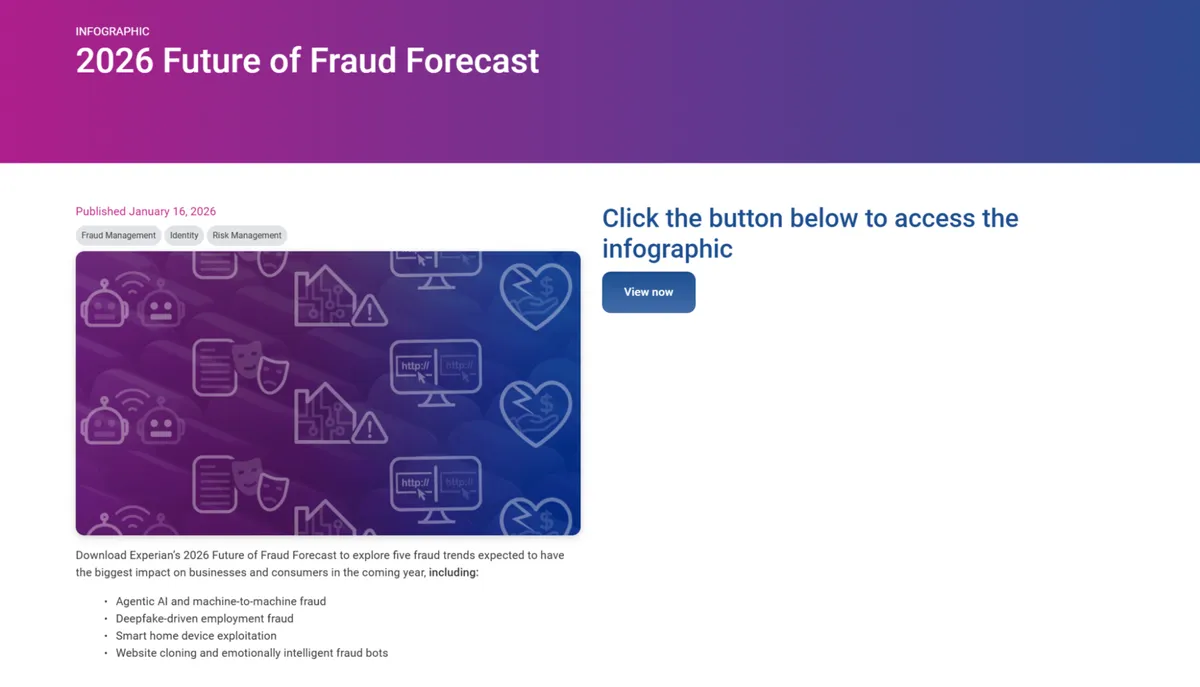
The Experian 2026 Future of Fraud Forecast shifts the narrative toward “Machine-to-Machine Mayhem,” predicting that the emergence of “Agentic AI” will redefine the fraud landscape. Experian posits that as organizations deploy autonomous agents to accelerate workflows (with agents projected to account for 29% of all AI value by 2028), fraudsters will exploit these machines to commit new levels of digital fraud. This environment introduces a “Know Your Agent” (KYA) requirement, as it becomes harder to distinguish between a legitimate consumer AI agent and a malicious bot.
The report identifies “Deepfake Job Candidates” as a top threat for 2026. With remote work becoming the norm, fraudsters use generative AI to pass video interviews in real time, allowing them to be onboarded as employees with access to sensitive corporate systems. This is part of a broader “HR Fraud” trend that includes hyper-tailored resumes and the exploitation of employee benefit systems for identity theft.
Top 2026 Fraud Predictions and Strategic Shifts
The following table outlines the five fraud trends Experian expects will have the most significant impact on businesses and consumers in the coming year.
| Trend Name | Primary Threat Mechanism | Predicted Outcome |
| Machine-to-Machine Mayhem | Agentic AI exploitation | Impossible-to-ignore volume of M2M fraud. |
| Deepfakes Outsmart HR | Real-time video/voice clones | Infiltration of sensitive corporate systems. |
| Smart Home Exploitation | Hijacking humanoid robots/IoT | Physical and digital data vulnerability. |
| Website Cloning 3.0 | AI-driven spoofed domains | Overwhelming volume of phished credentials. |
| Emotionally Intelligent Bots | Generative AI romance scams | Faster, more damaging psychological fraud. |
Source: Experian 2026 Future of Fraud Forecast
Experian research shows a clear trend toward the “Convergence” of traditionally siloed functions. Currently, 87% of institutions anticipate a closer integration of credit, fraud, and financial crime functions by the end of 2026. This integration, often powered by a “Composite AI” approach that blends generative and predictive models, allows businesses to build a more accurate picture of risk exposure—such as detecting fraud disguised as credit defaults.
The report also emphasizes the “Trust Gap” between consumer expectations and business performance. While 78% of consumers expect businesses to act decisively on fraud, fewer than a third believe brands are transparent about how their data is used. Consumers are increasingly willing to share more data—76% in the UK and 65% in the US—if it leads to improved security, signaling that friction-right biometric authentication (trusted by over 75% of consumers) is the preferred path forward.
Conclusion
Thanks to innovative approaches to data gathering and analysis, Civoryx offers a clear competitive data advantage. The collective findings of the Civoryx, Sumsub, Veriff, Sift, TransUnion, Experian, and reports reveal a fraud landscape that has shifted from high-volume “noise” to high-precision “signal.” The overarching theme for 2026 is the erosion of traditional identity layers, replaced by a complex, AI-mediated reality where the intent of the actor is as important as their identity.
The transition to “Accountable Intelligence” is the primary defensive response for 2026. This involves not only deploying AI to fight AI but ensuring that these models are explainable and integrated across the entire credit and fraud lifecycle. The reports suggest that organizations must prioritize “Identity Orchestration”—the ability to layer biometric, behavioral, and device signals into a single, adaptive risk score that evolves in real-time as a user interacts with a platform.
Furthermore, the rise of “Agentic AI” fraud requires a fundamental rethink of authentication. The “Know Your Agent” (KYA) paradigm will become as critical as “Know Your Customer” (KYC) was a decade ago. As autonomous machines begin to act on behalf of humans, the security protocols of 2026 must be capable of verifying the intent, consent, and authorization of these digital entities. The reports collectively indicate that the businesses that succeed in this environment will be those that can successfully bridge the trust gap, turning robust fraud prevention into a competitive advantage rather than a mere operational cost.
The regulatory environment is also tightening, with the EU’s Digital Services Act and Visa’s VAMP 0.9% threshold creating clear financial and legal consequences for failure. Organizations are no longer asking if they will be targeted, but how they can sustain resilience in a world where fraud is automated, industrialised, and increasingly human-like. The 2026 indices serve as a sobering reminder that while technology has supercharged the fraud threat, it also provides the tools—through data collaboration, biometric liveness, and behavioral orchestration—to rebuild digital trust at scale.