Civoryx vs Sumsub: Trend Dashboard vs Fraud Detection — Which Do You Need?

The landscape of digital fraud has never been more hostile, complex, or fast-moving. We are operating in an era where artificial intelligence can clone a CEO’s voice in seconds, where synthetic identities are manufactured at scale, and where multi-step financial crimes are orchestrated across borders with terrifying efficiency. According to recent industry reports analyzing fraud attempts through 2025 and 2026, “sophisticated,” multi-step identity fraud now accounts for nearly 28% of all digital deception.
Against this volatile backdrop, organizations, researchers, and everyday users face a critical question: How do you stop what you can’t see coming?
The answer lies in understanding the difference between macro-level awareness and micro-level defense. In the fight against digital crime, two distinct paradigms have emerged. On one side, you have the trend dashboard—a high-level, data-driven radar that tracks the shifting attention of fraud globally. On the other side, you have active fraud detection—the operational gatekeepers that analyze biometric data and device fingerprints to physically block criminals from entering your platform.
To understand which approach you need, we must look at two of the most prominent tools representing these paradigms: Civoryx, the ultimate macro-level Global Fraud Index, and Sumsub, an enterprise-grade identity verification and active fraud prevention platform.
While they both operate in the same broader industry, they serve entirely different purposes. One exists to tell you what the world is searching for; the other exists to dictate who is allowed through your digital doors.
The Landscape of Modern Fraud
| Metric | Reporting Entity | Period | Statistical Value | Year-over-Year Change |
| Total Reported Cyber Crime Losses | FBI IC3 | 2024 | $16.6 Billion | +33% |
| Total Consumer Fraud Losses | FTC Sentinel | 2024 | $12.5 Billion | +25% |
| Percentage of Victims Reporting Loss | FTC | 2024 | 38% | +41% |
| Global Business Revenue Loss to Fraud | TransUnion | 2025 | 7.7% (Avg) | N/A |
| US Business Revenue Loss to Fraud | TransUnion | 2025 | $9.8% (Avg) | +46% |
| Projected Global Crypto Scam Inflows | Chainalysis | 2025 | $17 Billion | +24% |
| Identity Theft Financial Impact | BIIA | 2024 | $27.2 Billion | +19% |
| Fraud Multiplier (US FI Cost per $1 Loss) | LexisNexis | 2025 | $5.75 | +25% |
2024-2025 Macroeconomic Digital Fraud Indicators
Before diving into the tools, it is crucial to understand why different approaches to fraud prevention are necessary.
Fraud evolves exponentially faster than regulatory frameworks, consumer awareness campaigns, or standard news cycles can follow. Historically, by the time a specific scam type makes the evening news or trends on social media, it has already peaked. The fraudsters have extracted their value, abandoned the specific methodology, and moved on to a new vulnerability.
| Age Group | Complaints | Total Loss (USD) | Loss Severity / Risk Profile |
| Under 20 | 17,993 | $22.5 Million | Social Media / Gaming |
| 20-29 | 71,399 | $540.1 Million | Overconfident / Employment |
| 30-39 | 108,899 | $1.4 Billion | Digital Native / Investment |
| 40-49 | 112,755 | $2.2 Billion | Highest Complaint Volume |
| 50-59 | 84,540 | $2.5 Billion | Transitioning Wealth |
| 60-69 | 84,000+ | $2.1 Billion | Tech Support Scams |
| 70-79 | 50,000+ | $2.0 Billion | High Median Loss ($1,000) |
| 80+ | 12,500+ | $712 Million | Highest Median Loss ($1,650) |
US Demographic Impact of Digital Fraud (2024)
If you are only reacting to the headlines, you are inherently weeks or months behind the threat actors.
Conversely, relying solely on active, transactional defense mechanisms creates a different kind of blind spot. If a compliance team at a FinTech company is only looking at the transactions happening inside their own platform, they lack the broader contextual awareness of what is happening globally. They might catch a specific bad actor, but they miss the macro-trend indicating a massive, impending wave of a new type of chargeback abuse or crypto scam.
| Rank | Crime Category | Financial Loss (USD) | Complaint Volume | Lead Mechanism |
| 1 | Investment Fraud | $6,570,639,864 | 47,919 | Pig Butchering / Crypto |
| 2 | Business Email Compromise | $2,770,151,146 | Not Disclosed | Social Engineering |
| 3 | Imposter Scams | $2,950,000,000 | 845,806 | Bank/Gov Impersonation |
| 4 | Tech Support Scams | $1,464,755,976 | 53,369 | Remote Access Tools |
| 5 | Personal Data Breach | $1,453,296,303 | 64,882 | Credential Harvesting |
| N/A | Phishing / Spoofing | $44,200,000 | 193,407 | Entry Vector / SMS |
| N/A | Extortion | Not Disclosed | 86,415 | Sextortion / Threats |
2024 US Fraud Categories by Reported Loss and Volume
This dynamic creates a clear division of labor in the security space:
- Proactive Threat Intelligence: Tracking the cultural and digital footprint of fraud before it hits your specific infrastructure.
- Reactive and Preventive Operations: Executing identity checks, monitoring live transactions, and rejecting malicious traffic in real time.
Let’s explore how Civoryx and Sumsub master these respective domains.
Deep Dive into Civoryx — The Global Fraud Index
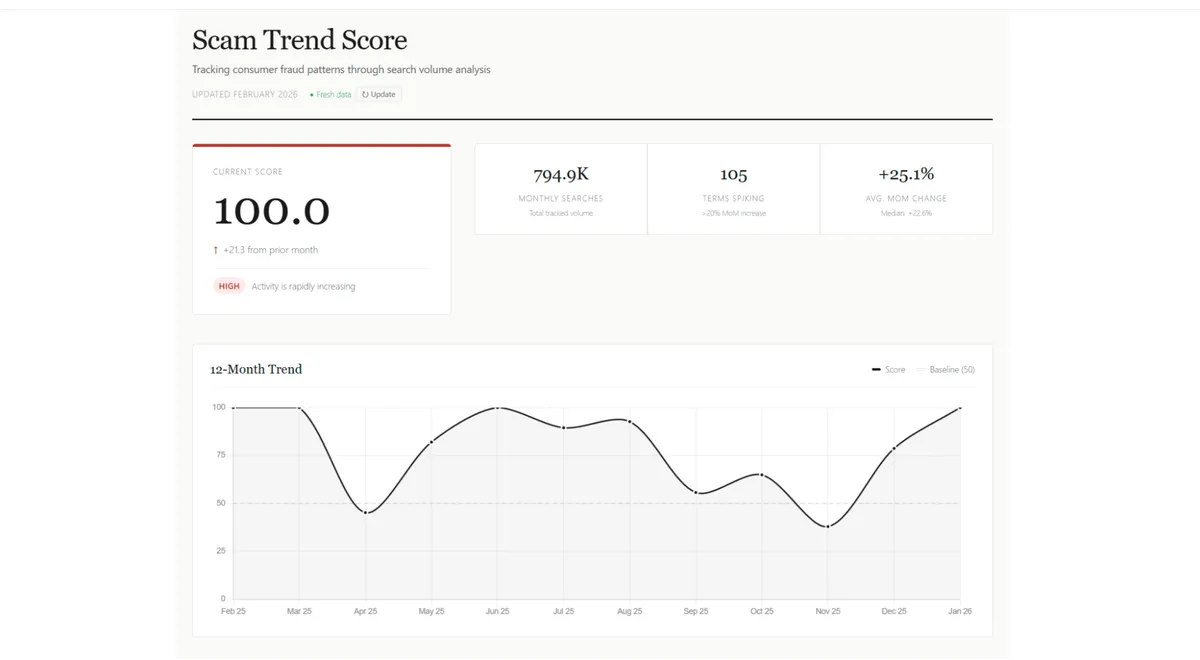
Civoryx is the Global Fraud Index. It operates on a fundamentally different premise than traditional cybersecurity software. Rather than verifying identities or monitoring bank transfers, Civoryx tracks how fraud attention shifts across the internet.
Why Does Civoryx Exist?
The core philosophy behind Civoryx is simple: Fraud evolves faster than headlines can follow. By the time a scam type makes the news, it’s already peaked. Civoryx was built to surface those subtle shifts early—giving researchers, journalists, businesses, and everyday users a real-time lens into what the world is searching for when it comes to fraud. It serves as an early-warning radar system for the internet.
When victims are targeted by a new phishing scheme, or when consumers begin questioning the legitimacy of a new cryptocurrency platform, they turn to search engines. By monitoring the volume and velocity of these queries, Civoryx captures the raw, unfiltered reality of the scam ecosystem.
No opinions. No speculation. Just data.
The 2022 Milestone: Expanding the Radar
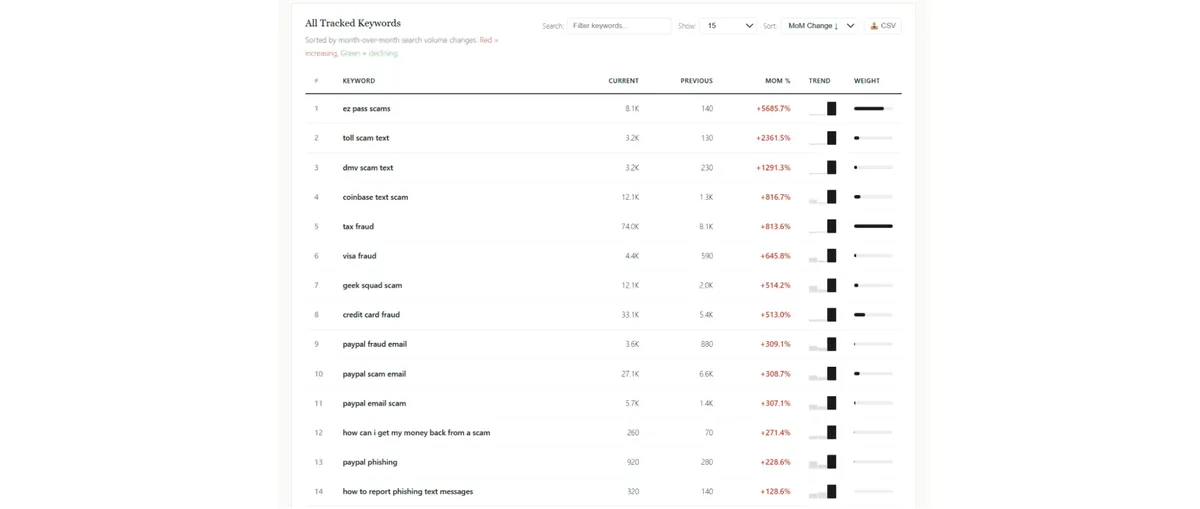
To accurately map the modern scam ecosystem, a tracking tool needs vast and nuanced data points.
A pivotal moment in the platform’s history occurred in 2022, when Civoryx expanded its keyword tracking from 80 to 150 fraud terms. This expansion was not just a minor update; it was a massive recalibration necessary to keep pace with an exploding threat matrix.
Prior to 2022, tracking 80 keywords covered the foundational bases—basic credit card theft, standard phishing, and traditional identity fraud. But as decentralized finance (DeFi) rug pulls, sophisticated romance scams (like “pig butchering”), AI-driven voice cloning, and synthetic identity fraud surged, the old index was no longer sufficient. By nearly doubling the tracked lexicon to 150+ terms, Civoryx ensured its index remained the most accurate reflection of the modern, rapidly mutating digital underworld.
How Civoryx Works: Three Layers
Civoryx distills millions of global data points into an easily digestible format using a strict, three-layer methodology:
- Monitor: Civoryx continuously tracks search volume for 150+ fraud-related keywords. This curated list spans a massive spectrum of malicious activity, including phishing, identity theft, crypto scams, romance fraud, and more.
- Measure: The system calculates the month-over-month (MoM) change for each individual keyword and weights it by its absolute search volume. This mathematical weighting is critical: high-volume keywords that suddenly spike carry significantly more signal than niche, low-volume terms filled with statistical noise.
- Score: The weighted changes across all 150+ keywords are aggregated into a single composite metric: the Scam Trend Score.
The result is a single, transparent signal of where scam activity is trending.
Who Is Civoryx For?
Civoryx is designed for anyone who needs to understand the macro fraud landscape:
- Cybersecurity Professionals and Compliance Teams: To anticipate the next wave of attacks and adjust their internal risk rules accordingly.
- Journalists and Researchers: To find hard, data-driven evidence of emerging scams before they become mainstream news.
- Everyday Consumers: To stay ahead of emerging threats and protect themselves from trending malicious campaigns.
Civoryx Pricing: Free
Unlike traditional security tools that lock their insights behind massive enterprise paywalls, Civoryx is a public index.
There are no paid tiers. There are no premium plans. There are no gated features:
- Public Access: Yes
- Scam Trend Score: Yes
- 150+ keyword index: Yes
- Month-over-month trend data: Yes
- No account required: Yes
- Cost: $0
The creators of Civoryx operate on a core belief: Fraud transparency shouldn’t have a price tag. The data is open because the problem is universal.
Deep Dive into Sumsub — The Fraud Prevention Fortress

If Civoryx is the weather radar telling you a hurricane is forming, Sumsub is the reinforced concrete, storm shutters, and automated security system physically protecting your house.
Sumsub is a massive, enterprise-grade technology company that specializes in identity verification, Anti-Money Laundering (AML), Know Your Customer (KYC/KYB), and continuous transaction monitoring. It is an all-in-one platform designed to fight digital fraud on the front lines and help regulated businesses stay strictly compliant with global laws.
Why Does Sumsub Exist?
While knowing that a scam is trending is valuable, a FinTech app, crypto exchange, or online marketplace still has a legal and financial obligation to ensure that the person signing up for an account is exactly who they claim to be. If a fraudster uses stolen documents to open an account and launder money, the business faces devastating chargebacks, severe regulatory fines, and catastrophic reputational damage.
Sumsub exists to automatically differentiate between legitimate users and malicious actors at the exact moment of interaction.
How Does Sumsub Works: The Micro-Level Defense
Sumsub does not track global internet search trends. Instead, it analyzes the specific, granular details of a user attempting to interact with a client’s platform. It combines identity, device, behavioral, network, and transactional checks into a single AI-powered engine.
- Advanced Identity Verification (KYC/KYB): Users are prompted to upload government-issued ID documents. Sumsub’s algorithms check the documents for authenticity, image integrity (detecting Photoshop or pixel manipulation), and validate the data against external government databases.
- Liveness & Face Match Biometrics: To prevent fraudsters from using stolen photos, deepfakes, or masks, Sumsub requires users to pass an advanced liveness check. This often involves 3D facial mapping or requiring the user to record a short video pronouncing specific numbers.
- Fraud Network Detection: This is where Sumsub’s AI truly shines. It doesn’t just look at isolated users; it looks at clusters. Through complex network analysis, Sumsub unveils connections between accounts using similar templates, originating from the same IP addresses, or sharing device fingerprints. If a bot farm in one country is trying to create 500 accounts using slightly altered credentials, the Fraud Network Detection tool clusters them and blocks the entire network simultaneously.
- Transaction Monitoring (KYT): Fraud prevention doesn’t stop at onboarding. Sumsub monitors user activity and financial transactions in real-time, analyzing behavioral intelligence and flagging anomalies (like a user suddenly transferring large sums to a high-risk jurisdiction) to stop account takeovers and payment fraud.
Who is Sumsub For?
Sumsub is designed for businesses that handle money, sensitive data, or operate in highly regulated environments:
- FinTech and Banking: Neobanks and traditional institutions protecting accounts, credit lines, and ensuring AML compliance.
- Crypto Exchanges: Platforms needing to uncover money mules, prevent scams, and adhere strictly to the Travel Rule and global crypto regulations.
- iGaming and Gambling: Blocking bonus abuse, underage gambling, and risky players.
- Marketplaces and E-Commerce: Preventing chargeback fraud, counterfeit buyers, and account takeovers.
Sumsub Pricing: Enterprise SaaS
Because Sumsub involves heavy computational analysis, biometric processing, and access to secure global databases, it is a paid, enterprise-level Software-as-a-Service (SaaS).
While pricing scales based on volume and custom needs, standard configurations generally follow this structure:
- Basic Plan: Starts around $1.35 per verification, which covers Liveness & Face match, and standard document checks. Perfect for non-regulated businesses looking to deter fraudsters.
- Compliance Plan: Starts around $1.85 per verification, adding crucial regulatory features like AML screening, ongoing AML monitoring, and Proof of Address checks.
- Enterprise Tier: Custom pricing for large-scale operations requiring Non-Doc verification, Database validation, and full-scale Fraud Detection Network solutions.
These plans require monthly commitments (e.g., $149 or $299 minimums), making it an active operational expense tied directly to a business’s growth and risk-mitigation budget.
Civoryx vs Sumsub: Head-to-Head Comparison
To make the best decision for your needs, you must view these two platforms not as competitors, but as entirely distinct tools operating at different altitudes of the cybersecurity airspace.
| Feature / Metric | Civoryx | Sumsub |
| Core Function | Trend tracking & macro-level intelligence. | Identity verification & active threat blocking. |
| Primary Output | Scam Trend Score (based on search velocity). | Approve/Decline decisions, Risk Scoring, Alerts. |
| Data Source | Global search engine volume across 150+ keywords. | User IDs, biometrics, device intelligence, IP, transactions. |
| Implementation | Zero integration. Public web dashboard. | API / Mobile SDK integration required. |
| Actionability | Strategic. (Awareness, threat modeling, research). | Operational. (Blocking users, stopping payments). |
| Target Audience | Researchers, journalists, consumers, risk analysts. | App developers, compliance teams, regulated businesses. |
| Cost & Access | $0. Free, fully, permanently. No account needed. | Paid tiers per verification check. Minimum monthly commitments. |
The starkest difference lies in the timeline of the data.
Civoryx provides proactive awareness. If the Scam Trend Score for “crypto wallet recovery” spikes globally by 400% in a single month, Civoryx registers this anomaly immediately. It tells you that a massive, coordinated scam campaign is currently ravaging the internet, driving panicked victims to search for solutions. You have this data before these victims or fraudsters interact with your business.
Sumsub provides reactive/active blocking. Sumsub does not care what people are searching for on Google. Sumsub cares that an IP address in a high-risk jurisdiction is attempting to use a digitally manipulated passport to open a trading account on your app right now. It identifies the anomaly in the specific user’s interaction and blocks the action, protecting your specific ecosystem.
Real-World Scenarios — Which Tool Do You Need?
The question of “Which do you need?” is best answered by examining the specific problem you are trying to solve. Let’s look at three practical scenarios.
Scenario A: The Investigative Journalist or Threat Researcher
The Goal: Write an exposé on the shifting tactics of digital cartels or publish an academic paper on consumer vulnerability to emerging scams.
The Tool:Civoryx.
The Application: You don’t have a software platform, nor do you need to verify anyone’s passport. You need hard data. You visit the Civoryx dashboard and analyze the index. You notice that since Civoryx expanded to 150 keywords in 2022, the data clearly shows a massive migration away from traditional “email phishing” terms toward “AI deepfake extortion” terms. You use the month-over-month Scam Trend Score to prove, mathematically, that fraud is accelerating in the AI sector. Civoryx provides the unquestionable, data-backed foundation for your research at zero cost.
Scenario B: The Scaling FinTech Startup
The Goal: Launch a new peer-to-peer payment app in Europe and North America while adhering strictly to global Anti-Money Laundering (AML) laws and preventing chargebacks.
The Tool:Sumsub.
The Application: You are legally required to Know Your Customer (KYC). If a user signs up to send $5,000, you must prove they are not a sanctioned individual or a money mule. You integrate Sumsub’s API into your app onboarding flow. When a user downloads your app, Sumsub prompts them for an ID and a quick video selfie. In 30 seconds, Sumsub cross-references global databases, confirms the user’s liveness, clears them of AML watchlists, and greenlights the account creation. Sumsub acts as your automated compliance department and physical bouncer.
Scenario C: The Enterprise Risk Management Team (The “Better Together” Approach)
The Goal: Protect a massive global cryptocurrency exchange from highly organized, multi-step fraud syndicates.
The Tool:Both Civoryx and Sumsub.
The Application: In mature, enterprise-level cybersecurity, these tools are highly complementary. So:
- Your risk analysts monitor Civoryx weekly. They notice the Scam Trend Score is surging, specifically driven by massive absolute volume spikes in keywords related to “synthetic identity loans.”
- Armed with this macro-level intelligence, the compliance team logs into their Sumsub dashboard. They proactively tighten the rules for their Fraud Network Detection. They increase the strictness of the pixel analysis for ID verification and lower the threshold for triggering manual reviews on accounts showing shared device fingerprints.
- When the wave of synthetic identity fraudsters finally hits the exchange a week later, Sumsub’s newly tuned defenses catch and block 100% of the attempts. Civoryx provided the intelligence; Sumsub executed the defense.
Evaluating Your Organization’s Needs
When deciding where to allocate your time, resources, or budget, ask yourself the following foundational questions.
Are you managing a platform where users can create accounts, move money, or access sensitive data?
If Yes, you absolutely need an active fraud detection and verification platform like Sumsub. It is not optional; in many jurisdictions, it is a strict legal requirement. A trend dashboard will not satisfy a government regulator during an AML audit.
Are you trying to understand the broader market, write a report, educate a consumer base, or predict upcoming threat vectors?
If Yes, you need Civoryx. It provides the cleanest, most transparent, and mathematically sound representation of the global fraud landscape without requiring a single line of code or a corporate budget.
Are you a consumer trying to stay safe?
Civoryx is your go-to resource. Checking the index can tell you if that new “investment opportunity” you’re seeing everywhere online is currently sparking a massive spike in global fraud searches.
Conclusion
| Strategy / Trend | Adoption Rate | Key Outcome |
| Consortium Analytics | High Growth | Identifying High-Risk Payees Pre-Clearing |
| FRAML Consolidation | 51% of FIs | Holistic Risk View / Better Efficiency |
| AI in Cyber Defense | 83% (ME) | Faster Vulnerability Patching |
| Behavioral Biometrics | Trending | Detecting Deepfakes and Bots |
| Digital Identity Wallets | Emerging | Stronger MFA / User Control |
| Machine-to-Machine Compliance | 2030 Horizon | Automated AI-Agent Reporting |
The evolution of digital deception requires a multi-layered response. Fraud is no longer just a technical problem; it is an industry, a behavioral science, and a global economy of its own.
Civoryx and Sumsub represent the absolute pinnacle of their respective domains. Civoryx acts as the internet’s early warning system, using its expanded 150-keyword index to aggregate global panic and curiosity into a single, undeniable Scam Trend Score—entirely for free. Sumsub, conversely, is the heavy machinery of the compliance world, using advanced AI, biometric liveness checks, and transaction monitoring to actively shield businesses from devastating financial and regulatory ruin.
You do not choose between a weather radar and a sturdy roof; you use the former to prepare, and the latter to survive.
FAQs
What were the total financial losses to digital fraud in 2024?
The scale of digital crime reached record levels in 2024. Reported losses to the FBI’s Internet Crime Complaint Center (IC3) exceeded 16.6 billion, a 33% increase from the previous year. Additionally, the Federal Trade Commission (FTC) reported that U.S. consumers lost more than 12.5 billion to fraud, representing a 25% jump from 2023.
How is artificial intelligence (AI) making scams more effective?
AI has significantly industrialized deception by increasing the speed and realism of attacks. AI-enabled scams are approximately 4.5 times more profitable than traditional scams, generating higher daily revenue (4,838 vs. 518) and a 9x increase in transaction activity. Furthermore, deepfake technology now drives 1 in every 20 identity verification failures, while AI-assisted document forgery rose from 0% in 2024 to 2% of all fake documents identified by late 2025.
Which age groups are most frequently targeted by fraudsters?
There is a distinct “value versus volume” divide across demographics. Individuals over the age of 60 suffered the highest financial impact, losing nearly 5 billion in 2024—the highest of any group. Conversely, younger generations are more likely to engage with scams; 43% of Gen Z and 39% of Millennials reported interacting with scam attempts, compared to only 14% of Boomers.
What is the “fraud multiplier” and why does it matter to businesses?
The fraud multiplier represents the total cost an institution incurs for every dollar lost directly to a fraudulent transaction. In 2025, this cost reached a record high of 5.75 for every 1.00 lost by U.S. financial services—a 25% increase since 2021. These costs include legal fees, recovery efforts, fines, and the loss of customer trust.
What are the primary trends in cryptocurrency-related crime for 2025?
Illicit cryptocurrency activity surged in 2025, with addresses receiving at least 154 billion—a 162% increase year-over-year. Stablecoins now dominate the illicit landscape, accounting for 84% of all criminal transaction volume. A major driver of this volume is nation-state sanctions evasion, exemplified by Russia’s ruble-backed A7A5 token, which transacted over 93.3 billion within its first year.
How are defense strategies evolving to counter these sophisticated threats?
Organizations are moving away from siloed security toward “FRAML” (Fraud + Anti-Money Laundering) platforms that integrate identity and behavioral signals to detect complex schemes. Another critical strategy is the use of consortium analytics, where financial institutions share anonymized data across a network to identify high-risk payees and “money mule” accounts before funds clear.
What is “pig butchering” and why has it become so prevalent?
Pig butchering is a high-yield investment scam where fraudsters “fatten up” a victim by building a romantic or professional relationship before “butchering” them through a fraudulent investment scheme. These operations are increasingly professionalized and often run from industrialized scam compounds in Southeast Asia that utilize forced labor. In 2024, investment fraud (including pig butchering) was the costliest crime category, resulting in over 6.5 billion in losses.