Civoryx Global Fraud Index Review: What Can Search-Based Scam Scores Actually Tell You?
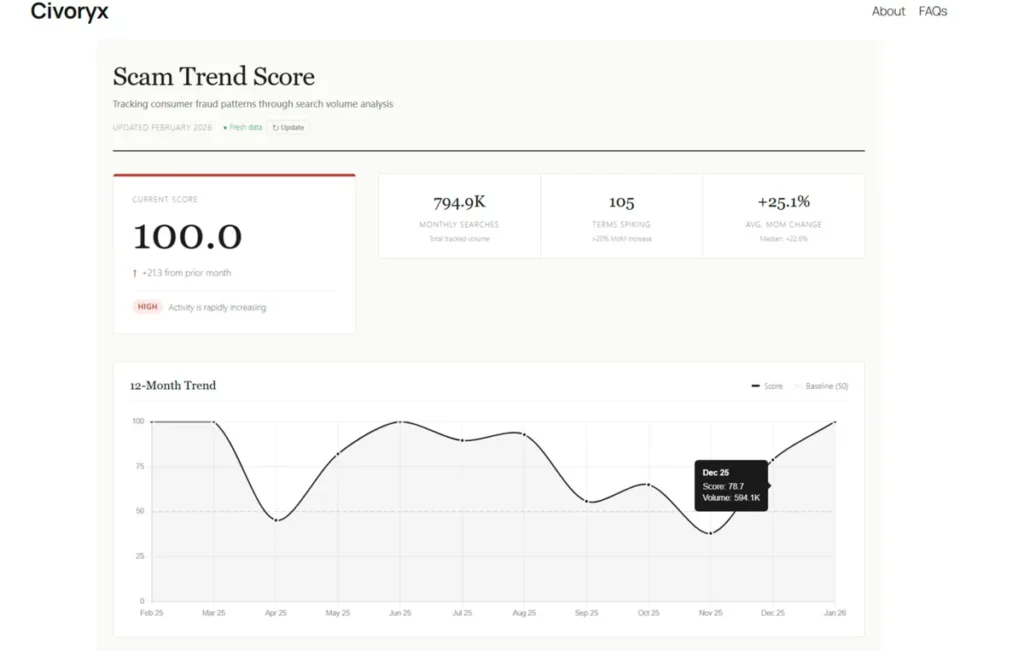
The modern fraud landscape is not a static battlefield; it is a highly fluid ecosystem of opportunistic campaigns, seasonal surges, and rapidly shifting attack vectors. In this environment, the traditional methods of tracking fraud—relying on post-incident reports, regulatory alerts, and law enforcement press releases—are inherently flawed. By the time a new phishing template or smishing (SMS phishing) campaign makes the evening news, the criminals have already extracted their illicit gains and moved on to the next vulnerability. Traditional reporting is a lagging indicator.
To proactively defend against financial and identity crimes, cybersecurity professionals, risk and compliance teams, and the general public need a leading indicator. They need a way to track the momentum of a scam before the total loss figures are tallied.
This is where the Civoryx Global Fraud Index enters the conversation. By tracking how fraud attention shifts across the internet using search volume data, Civoryx attempts to map the digital footprints of scams in near real-time. But what can a search-based scam score actually tell us about the real-world threat landscape? And just as importantly, what are its limitations?
This comprehensive review explores the mechanics, the data, and the practical utility of the Civoryx Scam Trend Score, analyzing how search velocity serves as a vital proxy for global scam activity.
The Core Philosophy: Tracking Attention, Not Just Incidents
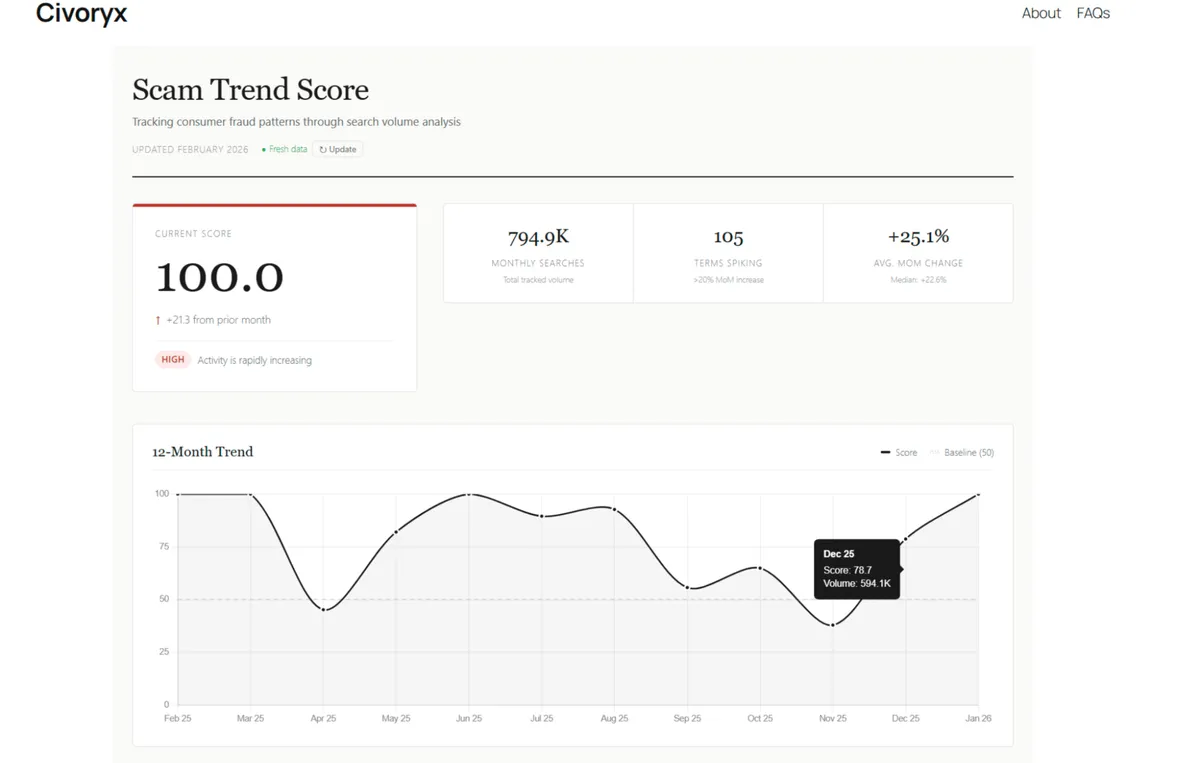
At its heart, Civoryx operates on a straightforward but powerful premise: when people are targeted by an unfamiliar text, email, or phone call, their first instinct is to search for it. Therefore, search volume acts as a massive, decentralized sensor network for malicious activity.
Civoryx captures this activity through its Scam Trend Score, a metric that aggregates month-over-month (MoM) search volume changes across a specific set of fraud-related keywords.
The guiding philosophy of the index is clearly stated by its creators: “No opinions. No speculation. Just data.”
This data-driven approach is critical because fraud evolves faster than headlines can follow. Civoryx was built specifically to surface these shifts early. It provides a real-time lens into what the world is searching for regarding fraud, stripping away the noise of anecdotal reporting and replacing it with quantifiable search momentum.
The 2022 Expansion: Scaling the Signal
To understand the current iteration of Civoryx, it is essential to look at its recent evolution. The vocabulary of fraud victims is constantly changing; the terms people searched for in 2019 are vastly different from what they search for today. Recognizing this rapid linguistic shift in how the public queries malicious activity, Civoryx expanded its keyword tracking from 80 to 150 fraud terms in 2022. This nearly twofold expansion was a pivotal moment for the index.
Moving from 80 to 150 keywords allowed Civoryx to capture a much more granular picture of the threat landscape. It enabled the tracking of highly specific, localized, or platform-centric scams—such as niche cryptocurrency wallet exploits or regional toll road phishing campaigns—that would have been swallowed by the noise of broader categories in a smaller index.
How it Works: The Mechanics of the Scam Trend Score
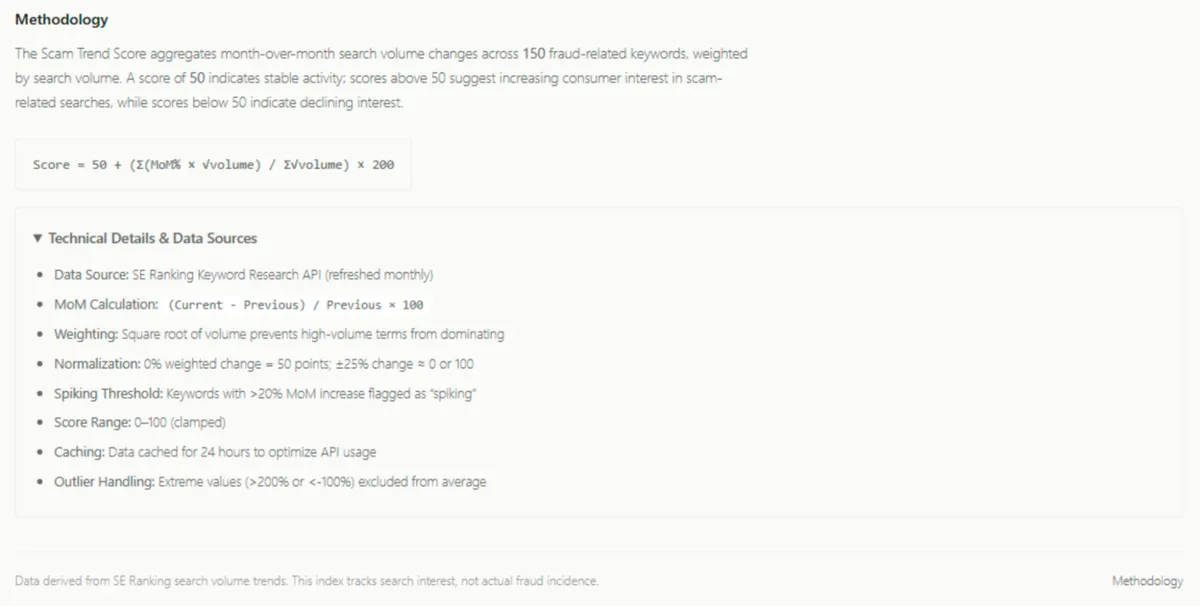
The Civoryx engine is built on a transparent, three-layered architecture designed to filter out statistical noise and highlight genuine threat momentum.
1. Monitor
Civoryx continuously monitors a curated index of 150+ fraud-related keywords. This lexicon spans a vast array of threat vectors, including:
- Phishing and smishing campaigns
- Identity theft queries
- Cryptocurrency and digital wallet scams
- Romance and relationship fraud
- Government and corporate impersonation
2. Measure
Tracking pure search volume is not enough; absolute numbers can be skewed by baseline popularity. Conversely, tracking only percentage growth can be misleading (e.g., a term jumping from 10 searches to 100 searches is a 900% increase, but represents negligible real-world impact).
To solve this, Civoryx calculates the month-over-month velocity of each keyword and weights it by its absolute search volume. High-volume keywords that experience sudden spikes carry significantly more signal weight than niche terms exhibiting noisy, low-volume fluctuations.
3. Score
The final layer aggregates these weighted changes into a single composite metric: the Scam Trend Score.
Mathematically, the fundamental logic of such a weighted momentum index can be expressed as:

Note: The exact proprietary scaling factors applied by Civoryx may vary, but the foundational principle remains volume-weighted momentum.
A rising score indicates that fraud-related search interest is accelerating on a global scale. A falling score means the ecosystem is cooling off, or that threat actors are in a transition phase between major campaigns.
Unpacking the Latest Data: A Highly Concentrated Threat Landscape
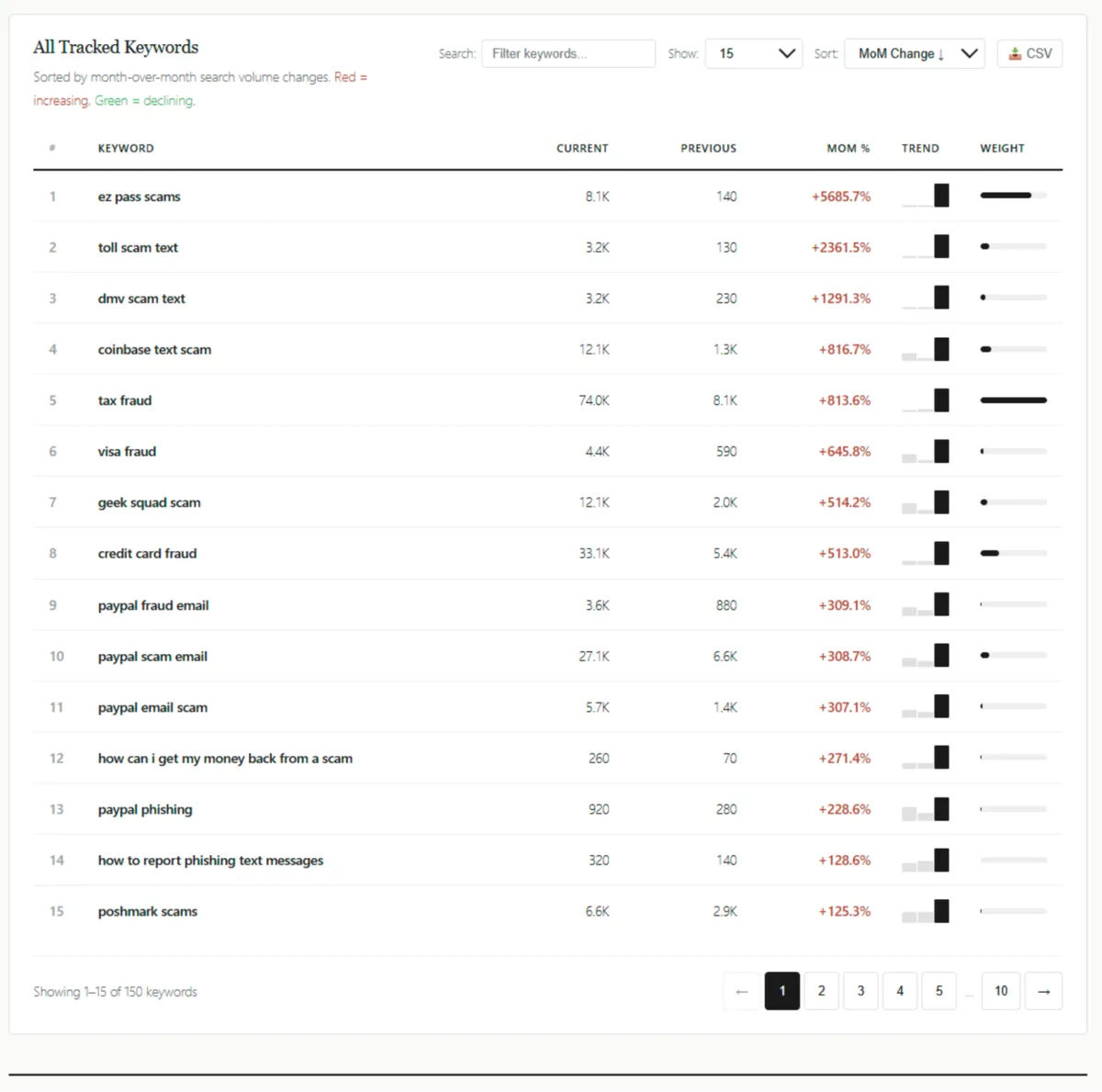
Analysis of the latest keyword dataset provided by Civoryx reveals a fascinating and highly concentrated signal. Currently, a very small cluster of specific themes is driving the vast majority of the index’s movement.
By looking at the top contributors to the score—those terms with the largest weighted impact—we can see exactly where global fraud attention is bottlenecking.
Top contributors to the score:
- tax fraud — contribution 75.74
- ez pass scams — 57.94
- credit card fraud — 21.36
- coinbase text scam — 12.43
- paypal scam email — 10.53
- toll scam text — 9.51
- geek squad scam — 7.83
- dmv scam text — 5.20
- visa fraud — 3.57
- paypal email scam — 2.20
Category Structure of the Signal
When these top contributors and the broader 150+ keyword index are grouped by intent, the composition of the current fraud landscape becomes glaringly obvious:
- Tax-related fraud: The single largest driver, contributing approximately 75.7 to the score.
- Payments & financial scams: Contributing roughly 56, split across traditional credit card fraud and digital wallet exploits.
- Messaging vectors (SMS/email/calls): Contributing roughly 15.6, heavily reflecting the delivery-channel risk (e.g., “toll scam text”).
- Phishing (generic): Contributing approximately 4, indicating a relatively stable, low-growth baseline.
- Reporting/prevention queries: Contributing roughly 1.7, showing lower overall growth compared to acute threat queries.
What Does This Concentration Mean?
From a risk management and compliance perspective, this heavy concentration is highly instructive. It indicates that seasonal financial fraud (evident in the massive 75.74 contribution of “tax fraud”) and infrastructure impersonation campaigns are currently exerting the strongest influence on the public’s attention.
Scammers are highly opportunistic. They align their campaigns with the calendar. During tax season, anxiety is high, and citizens are primed to expect communications from government entities. Threat actors capitalize on this by deploying massive volumes of tax-related phishing emails and texts, resulting in the massive search volume spike recorded by Civoryx.
The Rise of Infrastructure Smishing: Analyzing the Fastest-Growing Themes
While the weighted contribution tells us what is currently the largest problem, the month-over-month growth percentages tell us what the next major problem will be. The Civoryx dataset highlights unusually sharp growth in several infrastructure and payment-related scams.
The fastest-growing scam themes:
- ez pass scams — +5,685%
- toll scam text — +2,361%
- dmv scam text — +1,291%
- coinbase text scam — +817%
- tax fraud — +814%
- visa fraud — +646%
- geek squad scam — +514%
- credit card fraud — +513%
The Shift to SMS-Driven Impersonation
The most alarming trend in this dataset is the explosion of SMS-driven impersonation (smishing), specifically targeting civil infrastructure and daily inconveniences.
Look at the top three growth vectors: EZ Pass (+5,685%), Toll scams (+2,361%), and DMV texts (+1,291%).
Why are these specific scams accelerating so rapidly? The reasons:
- High Plausibility: Most people drive. Most people use toll roads. A text message claiming you owe a $4.50 unpaid toll balance is highly plausible.
- Low Dollar Value, High Urgency: These scams do not ask for a $5,000 wire transfer. They ask for a small, believable fee to avoid a large, fake penalty (e.g., “Pay this $4 toll now to avoid a $50 late fee and vehicle registration hold”). The low dollar amount bypasses the victim’s natural financial defenses.
- Data Harvesting: The goal of the toll scam is rarely just the $4. It is to drive the user to a fake, lookalike government portal to harvest their primary credit card details, which are then used for much larger fraudulent transactions (which correlates with the simultaneous +513% rise in generic “credit card fraud” queries).
Together, these staggering percentage spikes point to a clear, tactical channel shift by threat actors toward SMS. Email filters have become incredibly adept at catching the “Geek Squad scam” (though it still grew +514%), but telecom network filtering for SMS is still lagging behind. Compliance teams must use this data to reassess their customer-communication controls and alerting thresholds.
Declining Attention: The Death of the “Generic” Query
A critical aspect of analyzing any data index is looking at what is falling. Civoryx data reveals that not all fraud categories are rising. In fact, searches for broader, older, or more generic queries are experiencing a significant drop-off:
- is this a scam — -55%
- gift card scam — -46%
- mcafee scam — -45%
- brushing scam — -19%
- phishing — -18%
The Narrative-Driven Fraud Cycle
This divergence—where highly specific scam types (like “EZ pass scams”) are rocketing upward by thousands of percent while generic awareness queries (like “is this a scam”) are plummeting by 55%—is a fascinating psychological indicator.
It signals a narrative-driven fraud cycle.
When a few prominent, highly targeted threats dominate the landscape, public attention narrows. Consumers are no longer asking the internet broad, existential questions about their digital safety (“is this a scam”). Instead, they are asking highly specific, incident-driven questions (“coinbase text scam”).
This suggests that threat actors are abandoning broad, untargeted spam in favor of highly specific, localized, or brand-impersonation narratives. The drop in “gift card scam” queries (-46%) also indicates that public awareness campaigns by major retailers regarding gift card fraud may finally be reaching a saturation point, forcing scammers to pivot to new payment extraction methods (like the fake toll road portals).
Practical Applications: How the Industry Uses Civoryx
Data is only as valuable as the actions it enables. The February profile underscores the Scam Trend Score’s primary strength: rapid visibility into where fraud attention is concentrating right now. Because the index is updated regularly and displayed publicly—with no account required, no paywall, and no gating—it has become a widely adopted tool across several sectors.
For risk and compliance functions within banks, fintechs, and e-commerce platforms, the Civoryx signal supports several critical workflows:
1. Short-Term Threat Briefings
Security Operations Centers (SOCs) and Fraud Intelligence teams use the MoM percentage spikes to dictate their weekly threat briefings. If “DMV scam text” spikes by 1,291%, intelligence analysts immediately know to look for lookalike domains registered recently that mimic the Department of Motor Vehicles.
2. Customer Warning Campaigns
Marketing and customer communication teams use the index to time their educational outreach. If a bank sees “tax fraud” contributing a massive 75.74 to the global score, they can proactively push push-notifications and emails to their user base warning them about IRS impersonation tactics before the customer falls victim.
3. Prioritizing Transaction Monitoring Rules
Anti-Money Laundering (AML) and fraud compliance teams operate on limited resources; they cannot write custom rules for every conceivable scenario. The Civoryx index helps them prioritize. Seeing an 817% spike in “coinbase text scam” allows a traditional bank’s fraud team to temporarily tighten the risk scoring on outbound ACH transfers destined for cryptocurrency exchanges.
4. Context for Board-Level Risk Reporting
Chief Information Security Officers (CISOs) and Chief Risk Officers (CROs) use aggregate indices like the Scam Trend Score to provide macroeconomic context to the board of directors. If internal fraud losses rise by 5%, but the global Scam Trend Score is concurrently rising rapidly, the CRO can demonstrate that the organization is facing a systemic, industry-wide headwind rather than an internal control failure.
The Limitations: Attention Momentum vs. Actual Incident Volume
To accurately evaluate the Civoryx Global Fraud Index, we must apply candor and realism regarding its limitations. As with any search-based index, the Scam Trend Score measures attention momentum rather than confirmed incident volume or financial loss.
This is a crucial distinction. A massive spike in searches for a specific scam does not necessarily mean that the scam is successful. In many cases, it means the exact opposite.
If a threat actor blasts out 10 million text messages for an “EZ pass scam,” and 500,000 people immediately open Google and search “ez pass text scam real or fake,” Civoryx will register a massive +5,685% surge. However, those 500,000 searches represent users who were suspicious enough to check, meaning the scam likely failed on them.
Therefore, a high Civoryx score can sometimes indicate a highly visible but highly ineffective campaign. Conversely, the most dangerous, sophisticated, and targeted spear-phishing campaigns—those targeting high-net-worth individuals or corporate wire transfer clerks—will never generate enough search volume to trigger the Civoryx index.
Because of this, no serious cybersecurity professional uses Civoryx in a vacuum. Most organizations treat Civoryx strictly as a leading context indicator. It must be paired with:
- Internal case data and loss metrics
- Regulatory alerts (e.g., from FinCEN or the FBI IC3)
- Dark web monitoring for compromised credentials
- Confirmed transaction fraud rates
When Civoryx data is overlaid with these concrete, lagging indicators, it creates a complete and highly accurate risk picture.
Pricing and Accessibility: Democratizing Fraud Intelligence
Perhaps the most disruptive aspect of the Civoryx Global Fraud Index is not its methodology, but its business model. In a cybersecurity industry dominated by exorbitant enterprise licenses, opaque threat feeds, and heavily gated whitepapers, Civoryx takes a radically different approach.
What is the pricing model? Free.Fully.Permanently. Civoryx operates as a completely public index. There are no paid tiers, no premium “pro” plans, and no gated features designed to force user registration.
Public Access Features:
- Scam Trend Score: ✓ Included
- 150+ keyword index: ✓ Included
- Month-over-month trend data: ✓ Included
- No account required: ✓ Yes
- Cost: $0
The creators of the index operate on a specific ideological stance: “We believe fraud transparency shouldn’t have a price tag. The data is open because the problem is universal.”
This democratization of data is vital. While Tier 1 banks have million-dollar budgets for threat intelligence, local credit unions, small e-commerce merchants, independent journalists, and everyday consumers do not. By making the Scam Trend Score permanently public, Civoryx ensures that the organizations and individuals who are most vulnerable to these rapidly shifting attack vectors have the tools to see what is coming over the horizon.
Conclusion
The Civoryx Global Fraud Index is not a silver bullet for preventing financial crime. It will not tell you how much money was stolen yesterday, nor will it identify the specific threat actors behind a campaign.
What it will do, however, is provide an unparalleled, real-time pulse on the psychology of the targeted public. By systematically tracking 150+ keywords and weighting their month-over-month velocity, the Scam Trend Score transforms raw, chaotic search data into a coherent narrative.
The latest data paints a stark picture: we are currently in an environment dominated by seasonal tax anxiety and a massive, rapid shift toward infrastructure-based SMS impersonation (evidenced by the staggering surges in EZ pass and toll scams). Meanwhile, generic threats are fading from the public’s immediate attention.
By acknowledging its limitations and utilizing it as a leading indicator alongside internal telemetry, compliance teams, researchers, and consumers can use Civoryx to step out of a reactive posture and anticipate the fraud landscape’s next move. In a game where speed is everything, knowing what the world is searching for today is the best way to defend against the scams of tomorrow.
FAQ
1. What exactly is the Civoryx Global Fraud Index?
Civoryx is a free, public tool that tracks which scams are currently trending across the internet. It does this by monitoring search engine data for over 150 fraud-related keywords. By measuring how often people search for things like “tax fraud” or “EZ pass scam text,” Civoryx creates a “Scam Trend Score” that shows whether global attention on fraud is rising or falling.
2. How much does it cost to use Civoryx?
It is 100% free. The creators of Civoryx believe that fraud transparency shouldn’t have a price tag. There are no premium plans, no gated features, and you don’t even need to create an account to view the data.
3. Does a high Scam Trend Score mean more people are losing money?
Not necessarily. The score measures public attention, not actual financial losses. If millions of people receive a fake text message about an unpaid toll and immediately search Google to see if it’s real, the Civoryx score will spike. That spike actually means people are suspicious and investigating the threat, which often means the scam is failing to trick them!